Imagine this:
It’s 2030. Your job title hasn’t changed. Your industry is still here. But the skills that once made you confident in your role suddenly feel outdated.
According to the World Economic Forum’s Future of Jobs Report 2025, nearly 40% of the skills people rely on today will either disappear or change fundamentally by 2030.
The future of work isn’t about replacing people with machines.It’s about which skills will still make people valuable when technology becomes part of everything we do.
Why this data matters — and why it can be trusted
The Future of Jobs Report 2025 is based on a global survey of more than 1,000 employers, representing 14 million workers across 55 economies and 22 industry clusters.
Companies were asked two simple but powerful questions:
- Which skills are critical today?
- Which skills will be essential by 2030?
The result is not a list of future professions, but a map of how skills themselves are changing — regardless of job titles, industries, or seniority.
How to read the skills map
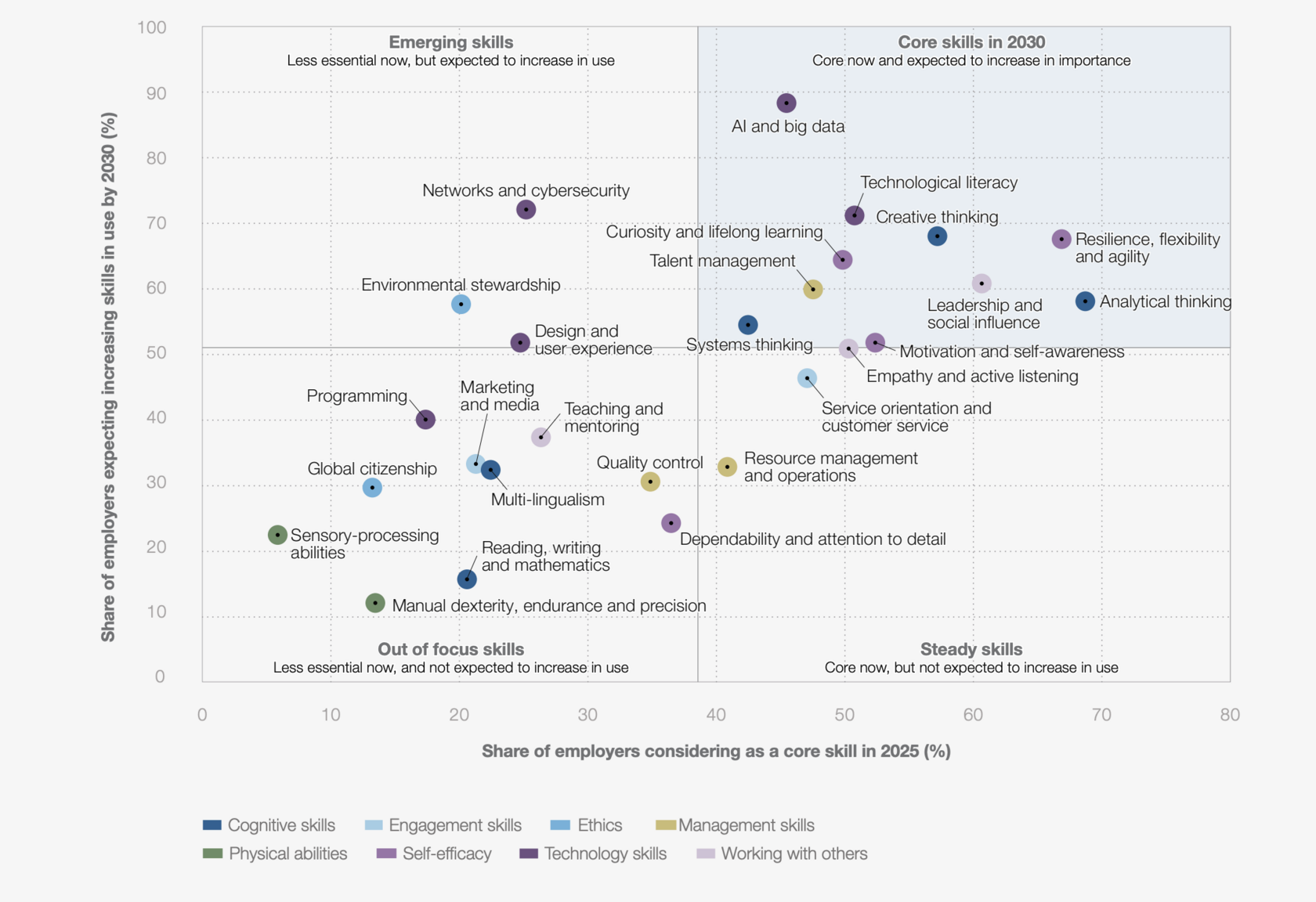
To make sense of these shifts, the report visualizes skills across two dimensions:
- How important they are today.
- How much their demand is expected to grow by 2030.
This creates four clear groups:
- Core Skills (2030) — already important and growing fast.
- Emerging Skills — not critical yet, but rising quickly.
- Steady Skills — important today, but not accelerating.
- Out-of-Focus Skills — declining in relevance and demand.
Understanding where your skills fall matters more than knowing your job title.
Core Skills (2030): the skills that will define employability
If you’re thinking about long-term career stability, this is the quadrant that matters most.
These are the skills employers already value — and expect to rely on even more by 2030.
Technology as the baseline, not the advantage
At the top of the Core Skills quadrant sit AI and Big Data and Technological Literacy.
By 2030, around 88% of employers expect AI and Big Data skills to be core.
Technological literacy — the ability to understand, use, and adapt to digital tools — is becoming a baseline requirement across roles.
In practical terms, this means something important: technology skills are no longer a differentiator. They are the entry ticket.
Having them won’t set you apart. Not having them will quietly limit your options.
This shift creates a growing risk for professionals who rely too heavily on a narrow set of technical skills.
The human skills that actually create long-term value
What’s more interesting is what surrounds those technology skills.
The data shows strong and sustained demand for deeply human capabilities, including:
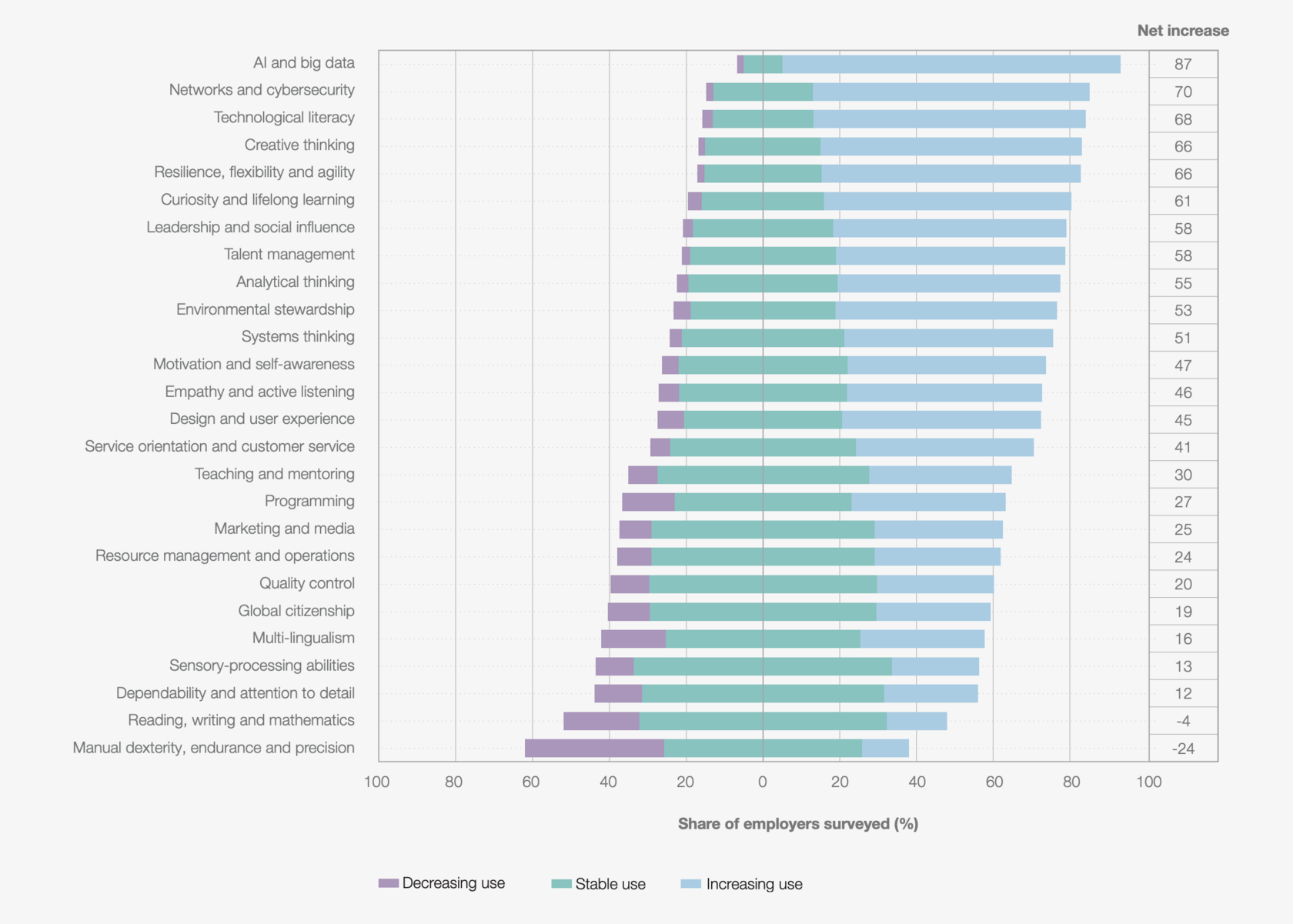
- Creative Thinking (60% → 73%).
- Analytical Thinking (75% → 73%).
- Resilience, Flexibility, and Agility (68% → 69%).
- Curiosity and Lifelong Learning (68% → 72%).
- Leadership and Social Influence (64% → 65%).
As automation absorbs routine tasks, these skills become more valuable — not less.
They allow people to:
- ask the right questions instead of just processing data.
- adapt when tools, systems, and roles change.
- make judgment calls in complex, uncertain situations.
- lead, influence, and collaborate in human systems.
AI-related skills may grow the fastest.
But long-term value is created where technology meets human judgment.
“Technology is moving so fast that relying on one fixed skill is becoming increasingly risky. Many technical skills will become niche or less relevant over time, but the ability to adapt, solve problems, communicate, and learn will matter more than ever.
The message is simple: start working on your soft skills now.”
— Andres Gavriljuk, CEO, Pragmatiq AI
Emerging Skills: what’s coming next
Beyond Core Skills, the report highlights Emerging Skills — capabilities that aren’t critical for most roles yet, but are expected to grow rapidly by 2030.
These skills often appear first:
- in innovative industries.
- in new regulatory or sustainability-driven contexts.
- in roles adapting to new business models.
For professionals, Emerging Skills act as early signals.
They show where demand is heading — and where proactive learning can create an advantage before the market catches up.
Steady Skills: important, but not defining the future
Some skills remain important — but their demand isn’t accelerating.
These Steady Skills support day-to-day operations and existing roles. They provide reliability and continuity, but on their own, they are unlikely to define future career growth or differentiation.
They still matter — just not as much as adaptability, learning capacity, and human judgment.
Out-of-Focus Skills: what’s losing relevance
The final quadrant highlights skills that are declining in both current relevance and future demand.
These include:
- Manual Dexterity, Endurance, and Precision.
- Basic Reading, Writing, and Mathematics.
This doesn’t mean these abilities are useless.
It means they are increasingly assumed as a baseline or automated by systems.
What matters more are advanced applications — such as systems thinking, analytical reasoning, and complex decision-making — where human contribution remains essential.
The hybrid professional: what success looks like by 2030
Taken together, these shifts point to a new professional profile.
Not a tech specialist, not a soft skills expert. But a hybrid.
1. Technology-driven capabilities
- AI and Big Data
- Networks and Cybersecurity
- Technological Literacy
These skills are becoming broadly relevant across roles, not limited to technical positions.
2. Cognitive skills for complexity
- Creative Thinking
- Analytical Thinking
- Systems Thinking
They enable people to work effectively in AI-supported environments.
3. Self-efficacy and learning-oriented skills
- Resilience, Flexibility, and Agility
- Curiosity and Lifelong Learning
- Motivation and Self-Awareness
These skills support continuous adaptation rather than mastery of a fixed toolkit.
4. Human and social capabilities
- Leadership and Social Influence
- Empathy and Active Listening
- Service Orientation and Talent Management
They remain essential wherever people work with people.
What this means in practice
For Business Leaders
The WEF data highlights three clear priorities:
- Technology training remains essential, but competitive advantage increasingly comes from developing creative, analytical, and adaptive capabilities across teams.
- AI adoption is not only a technical challenge. Organizations must actively prepare employees to work alongside AI and apply human judgment in decision-making.
- Learning agility, curiosity, and the ability to evolve are becoming more valuable than static expertise tied to specific tools.
For Individual Professionals
For individuals, the direction is equally clear:
- Develop technological literacy alongside cognitive and human skills such as problem-solving, communication, and leadership.
- With nearly 40% of skills expected to change by 2030, staying relevant requires ongoing learning rather than occasional upskilling.
- Judgment, creativity, empathy, ethical reasoning, and the ability to work with and lead others remain uniquely human — and increasingly valuable.
What This Means for Your Career
The future of work is not a competition between humans and technology.
It’s a redefinition of how value is created — through collaboration between advanced tools and human capabilities.
The 2030 skills shift is already happening.
The real question is not whether work will change — but whether your skills are changing with it.
Source: World Economic Forum. "Future of Jobs Report 2025."