
AI is everywhere in the headlines — but for most companies, the practical question remains the same: where do we actually start? And just as importantly, how do we fund the first steps without committing to a large investment upfront? Estonia has several active funding programmes designed exactly for this. In this article, we break down what's available, who qualifies, and how these programmes connect to each other.
Why This Matters Now
For many Estonian companies — especially in manufacturing, logistics, and services — the biggest barrier to AI isn't a lack of interest. It's the practical question of how to evaluate opportunities, build a business case, and fund the early stages without taking on too much risk.
That's exactly what the Estonian government and EU-backed programmes are designed to address. Through a combination of Enterprise Estonia (EIS) grants and the AIRE digital innovation hub, companies can access structured support at every stage: from mapping their first AI use cases to running a real production pilot.
The total available support across all programmes can reach approximately €135,000.
Programme 1: EIS Digitalisation Roadmap — Your Starting Point
Status: Open | Max grant: €10,000 | Your co-financing: 30–50%
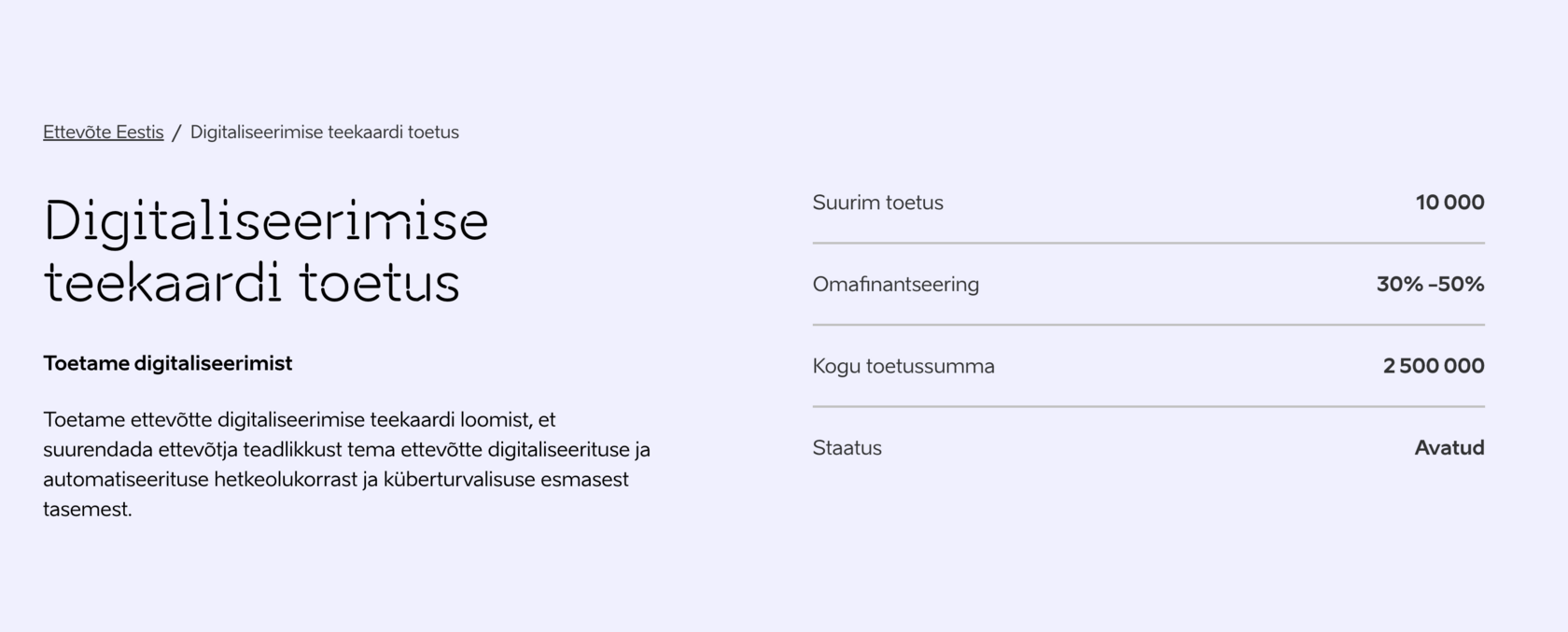
If you haven't done any formal digitalisation planning yet, this is where to start. The Digitalisation Roadmap grant from Enterprise Estonia (EIS) funds the creation of a strategic document that maps out your company's digitalisation opportunities.
What you get:
A structured assessment of your business model, supply chain, and production processes — with a focus on identifying bottlenecks that AI, automation, or digital technologies can solve. The output is a 3-year action plan with ROI estimates for each initiative, typically covering 5–10 potential use cases.
Who can apply:
Any Estonian-registered company (SME or large) with an average annual revenue of at least €200,000 over the previous two financial years. You must not have previously received "digidiagnostika" support. Some sectors (fossil fuel extraction, for example) are excluded.
How it works in practice:
The roadmap is developed by a team that includes your key people and an external consultant. The process typically takes 3–6 months. For companies in Tallinn, Harju County, and Tartu, EIS covers 50% of costs; outside these regions, the coverage rises to 70%.
Why it matters for AI specifically:
The roadmap isn't just about software purchases. It's the document that later unlocks access to larger funding — both the EIS consulting support and the AIRE demo projects. Think of it as your business case for AI, validated by an independent expert.
Programme 2: EIS Roadmap Consulting & Development
Status: Open | Max grant: €35,000 | Your co-financing: 30–50% | Total programme budget: €2,500,000
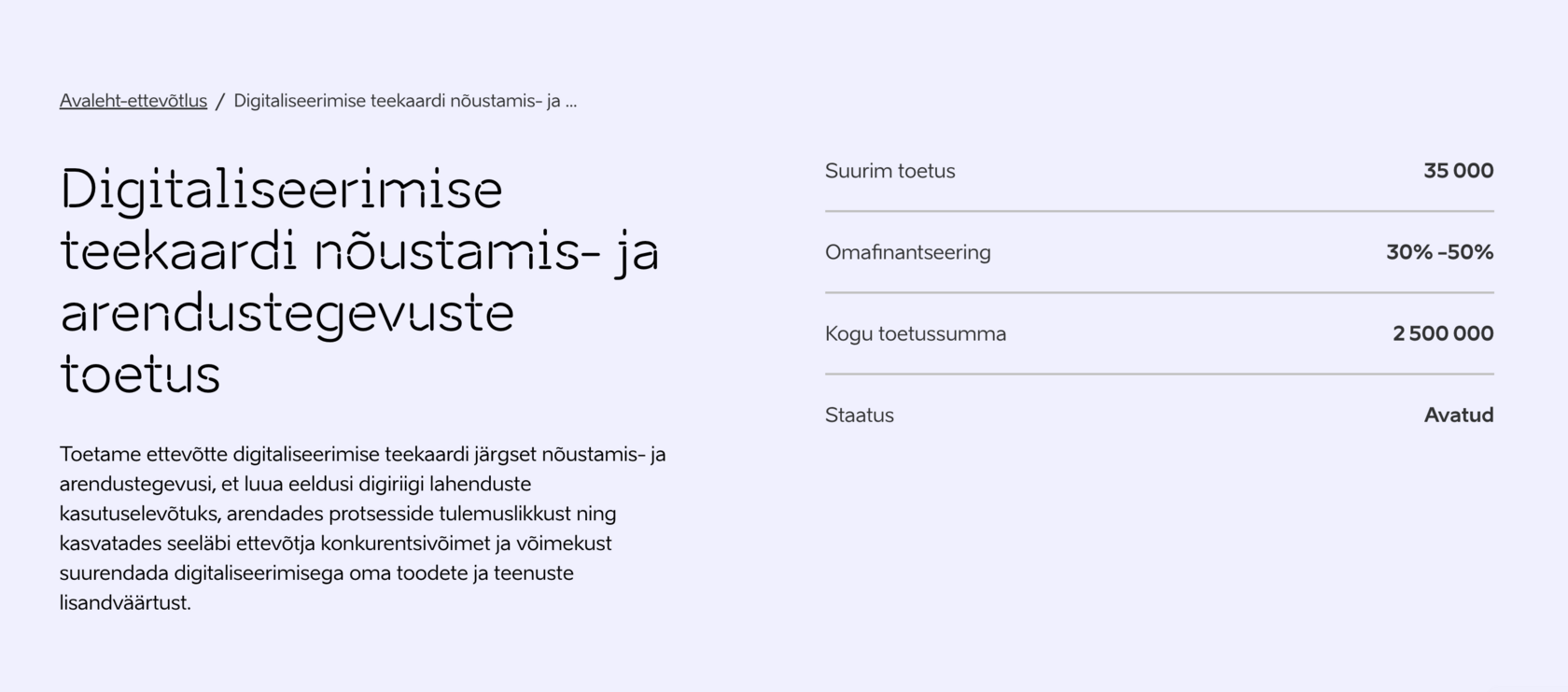
Once you have a digitalisation roadmap in place, the next step is the Consulting & Development grant, which funds hands-on work to resolve the bottlenecks your roadmap identified.
What it covers:
This programme supports advisory and development activities directly linked to your roadmap findings. Eligible activities include AI feasibility studies and data readiness assessments, process redesign for automation, vendor selection and pilot specifications, and cybersecurity assessments.
Each activity must produce a documented process and output — this isn't a vague consulting engagement, but structured project work.
Eligibility:
Same revenue threshold as the Roadmap grant (€200,000 average over 2 years), plus you must already have a completed digitalisation roadmap.
Programme 3: AIRE (EDIH) — "Test Before Invest" with AI
Status: Currently closed — relaunching in updated form in Q1 2026 | Previous demo project budget: up to €90,000
AIRE (AI & Robotics Estonia) is Estonia's European Digital Innovation Hub, co-funded by the EU's Digital Europe Programme and the Estonian Ministry of Economic Affairs. It was created specifically to help manufacturing SMEs adopt AI and robotics — and it recently secured funding for a second period (2025–2028), with an expanded target group.
AIRE's demo project service is currently closed as the programme transitions to its new funding period. It is expected to relaunch in an updated form and for a broader target group in Q1 2026. In previous rounds, demo project budgets reached up to €90,000 per project, with the state covering a significant portion of costs. It's worth preparing now so you're ready to apply as soon as the new round opens.
What AIRE offers:
- AI Consulting (AI Suitability Assessment) — An expert assessment of your company's readiness for AI. This includes mapping your current digital maturity, evaluating specific use cases, and identifying the data, infrastructure, and skills you need. The service is provided free of charge to the company, but registered as state aid (de minimis).
- AI Training — Structured courses on AI, robotics, and digital technologies delivered by experts from TalTech, University of Tartu, and Estonian University of Life Sciences. Covers both strategic understanding for managers and practical skills for technical teams.
- Test Before Invest Demo Projects — The flagship service. AIRE pairs your company with a university research team to build and test a real AI or robotics solution for your specific challenge. This is not a cash grant — AIRE provides the university expertise, research infrastructure, and project support directly. You must complete a Digital Maturity Assessment before applying.
What kinds of projects have been supported?
Past AIRE demo projects have tackled challenges like automated logistics in food production, AI-powered quality control for pallet labelling, production process optimisation at robotic workstations, and autonomous indoor navigation for smart robots. The key requirement is that the solution must be innovative — it shouldn't duplicate what's already available on the private market.
What's coming for 2025–2028:
AIRE is expanding beyond manufacturing to include health technologies, introducing an AI Helpdesk service, offering guidance on the EU AI Act, and building cross-border collaboration with other European Digital Innovation Hubs.
Sources: AIRE — Demo projects
The Recommended Path: How These Programmes Work Together
The real power of these funding instruments is how they stack. Rather than applying to one programme in isolation, consider a step-by-step approach:
- Step 1 → Digitalisation Roadmap (EIS, up to €10,000). Map your AI and automation opportunities with ROI estimates. This creates your strategic foundation and unlocks access to follow-up funding.
- Step 2 → Consulting & Development (EIS, up to €35,000). Dive deeper into feasibility studies, data readiness, process redesign, and pilot specifications for your highest-priority use cases. (Opening soon — keep an eye on the EIS website.)
- Step 3 → AI Pilot via AIRE (previously up to €90,000). Take your top use case into a real production environment. Test AI solutions like computer vision for quality control, predictive maintenance, or intelligent production planning — with university expertise and minimal financial risk. (Demo project service relaunching in Q1 2026.)
Combined, these programmes can provide up to approximately €135,000 in support (depending on programme availability and de minimis limits) to move from an initial assessment to a working AI pilot in your production environment.
Key Eligibility Rules to Keep in Mind
Before you start planning, there are a few common requirements across these programmes:
De minimis aid cap: The total state aid your company has received must not exceed €300,000 over the current and two preceding fiscal years. All three programmes count toward this cap, so plan accordingly.
Revenue threshold: Your company must have earned at least €200,000 in average annual revenue (in your main field of activity in Estonia) over the previous two financial years.
Documentation matters: Each programme requires specific outputs — a roadmap report, activity documentation, or a demo project deliverable. This isn't "apply and forget" funding; it's structured support that expects measurable results.
Sector restrictions: Some industries (primarily fossil fuel extraction and related activities) are excluded from EIS grants.
How to Get Started
Navigating grant programmes takes time — between eligibility checks, application forms, required documentation, and coordinating with external consultants, it can easily become a project in itself.
If you'd rather focus on running your business, we at Pragmatiq AI can take this off your plate. We work with Estonian companies on AI adoption every day and know these programmes inside out. We'll help you pick the right funding path, prepare the application, and make sure nothing gets stuck in the process.